Patience, presence, and a lifetime of experience — grandparents have what it takes to help grandchildren thrive.
Parents today juggle jobs, household duties, and school emails from three different teachers. Something has to give.
That is where grandparents fit in. They have the time that working parents often lack. They bring patience built from raising their own children. They also see the bigger picture because they have lived through different school eras.
Children do better with a calm adult nearby. Tests keep coming. Grandparents and homework go hand in hand — they offer help without crowding out parents.
In fact, 42% of grandparents report helping their grandchildren with homework or school projects at least once a week — and 87% say their involvement helped their grandchildren improve.
Here is how grandparents help kids thrive — one simple strategy at a time.
Know a little about how schools work now
Not a lot. Just enough to follow along when a grandchild is describing their day.
Schools lean heavily on technology and collaborative work. Teachers use classroom AV strategies that support student participation, things like group video discussions, interactive boards, and peer presentations. It looks nothing like the classroom where most grandparents sat in.
Knowing that school is more interactive now makes those after-school conversations much easier to follow and much more useful for the kid telling you about them.
A tip for parents: Give grandparents a two-minute tour of the kid’s online classroom portal. Just show them where to find assignments and messages. That small peek makes the grandparent feel less lost.

Read together every week
Kids who read well tend to get better grades. Grandparents can help by making reading feel like a shared activity rather than homework. Go to the library together. Let the child pick whatever looks fun. Comic books count. Picture books count. Even reading the same dinosaur book for the tenth time counts.
Read aloud and pause. Ask something like “What happens next?” or “Why did she do that?” You don’t need to be a teacher. You just need to be there.
A grandparent with low energy can still manage twenty minutes on the couch. No games. No running around. Just reading. That short time adds up. Vocabulary and attention span grow, and the child begins to see reading as a good way to spend time.
What works best:
- Pick a regular time, such as Sunday afternoon
- Follow the child’s interests, not a reading-level chart
- Trade pages: you read one, and the child reads one
A tip for parents: Let the grandparents know what the class is reading. A quick text with the book title helps. Then grandparent and child have something specific to talk about.

Turn daily tasks into math practice
Math can look like a bunch of nonsense on a page. Kids get confused. The good news is that how grandparents can help is simpler than it sounds — just use regular errands.
Bake cookies. That is fractions right there. Go to the grocery store. That is addition and figuring out which costs less. Pull weeds or plant seeds. That is measuring and counting.
A grandparent just says normal things out loud. “Can you scoop out half a cup of flour? Show me what half looks like.” Or “These apples cost two dollars. We have five dollars. How much do we get back?”
The kid learns because the numbers actually mean something. They are not just problems for a grade. They are about cookies and apples and dirt.
A tip for parents: Tell the grandparents what math the class is covering this month. Fractions, money, measurements. Then they can slide those words into the conversation without making it a lesson.
Support homework without doing it for them

Homework time can get tense when parents are tired from work. Grandparents bring a different energy. Calmer, slower, and less rushed.
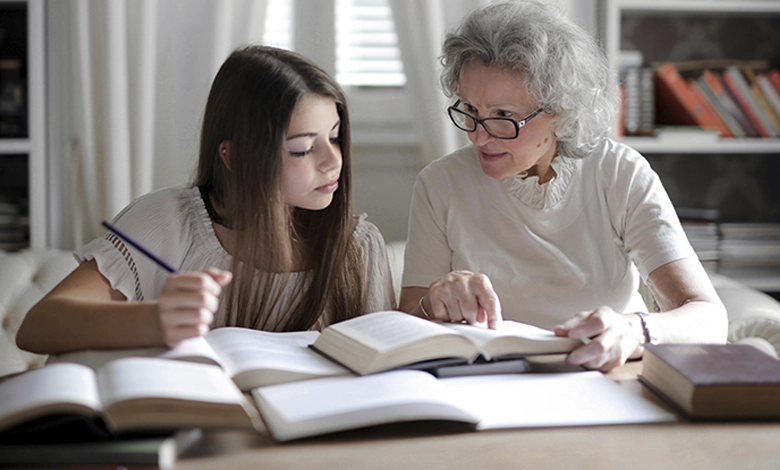
Set up a spot at the kitchen table. Pour some water. Put out a small snack. Then ask, “What is the assignment about?” Let the child explain it to you. That explanation alone helps the kid figure out what they need to do.
If the child gets stuck, do not hand over the answer. Try something like, “Where does the teacher want you to start?” Or “Show me what you already tried.”
Some grandparents have no idea how to do the new math or the different reading methods. That is fine. You do not need to know the content. Just sitting nearby while the child works keeps them on track. Someone is watching. That is enough.
A tip for parents: Remind the grandparents that helping with homework does not mean knowing the answers. It means being a warm body at the table. Also, give them a heads-up if the child has a big project due. That way, they can ask good questions without spoiling the surprise.

Share family stories and history
Kids need more than test scores to get through school. They need to know that learning is something real people do. Grandparents have a lifetime of proof.
Tell the kid about your own school days. The class you nearly failed. The teacher who pulled you aside and helped. The time you lost your homework and had to talk your way out of it. Or how you figured out a problem when no one could Google the answer.
Those old stories do something useful. The child feels like they are not alone. Other people struggled too. Other people figured it out. So when a kid says, “I am bad at math,” a grandparent can answer, “So was I. Here is how I got through it.”
Grandparents and school success are more closely connected than most people realize. Did you know that grandparents who spend time with their grandchildren also benefit? Research shows that babysitting your grandkids is good for your brain — and the legacy you pass on goes far beyond schoolwork.
A tip for parents: Let the grandparents have some quiet time with the kids without a schedule. The good stories come out when no one is rushing to the next activity.
The bigger picture
A grandparent does not need to understand every new teaching method or every piece of classroom technology. Kids just want someone who pays attention to them, shows up week after week, and listens when they explain something slowly, even if it does not make complete sense.
Grandparents helping grandchildren thrive in school is less about knowing the right answers and more about showing up. That patient, unhurried attention goes a long way — it helps kids learn better than any app or flashcard set.
Grandparents helping kids succeed in school — your questions answered
How can grandparents help grandchildren with school without overstepping?
The key is to support, not to take over. Ask questions rather than giving answers. Be present without pressuring. Let the child lead the conversation about their day. Grandparents who listen and encourage, without trying to replicate the classroom, make the biggest difference.
What if grandparents don’t understand how schools teach now?
That’s perfectly fine. Grandparents don’t need to know the content to help with homework — they just need to show up. Sitting with a child, asking what the assignment is about, and offering encouragement are more valuable than knowing the right answer.
How much time should grandparents spend helping their grandchildren with school?
Even twenty minutes a week makes a measurable difference. Consistency matters more than duration. A regular reading session, a weekly baking project, or a standing homework date builds trust and routine — both of which help children thrive academically.
Can grandparents helping grandchildren benefit the grandparents, too?
Absolutely. Research shows that spending meaningful time with grandchildren supports cognitive health and emotional well-being in older adults. The relationship is genuinely good for everyone involved.
You just read one of our favorite stories. There’s more where this came from — subscribe, and we’ll bring them to you every Tuesday.